Your Attention, Please
Hours of time wasted. Attention fragmented. It’s time for a better approach.
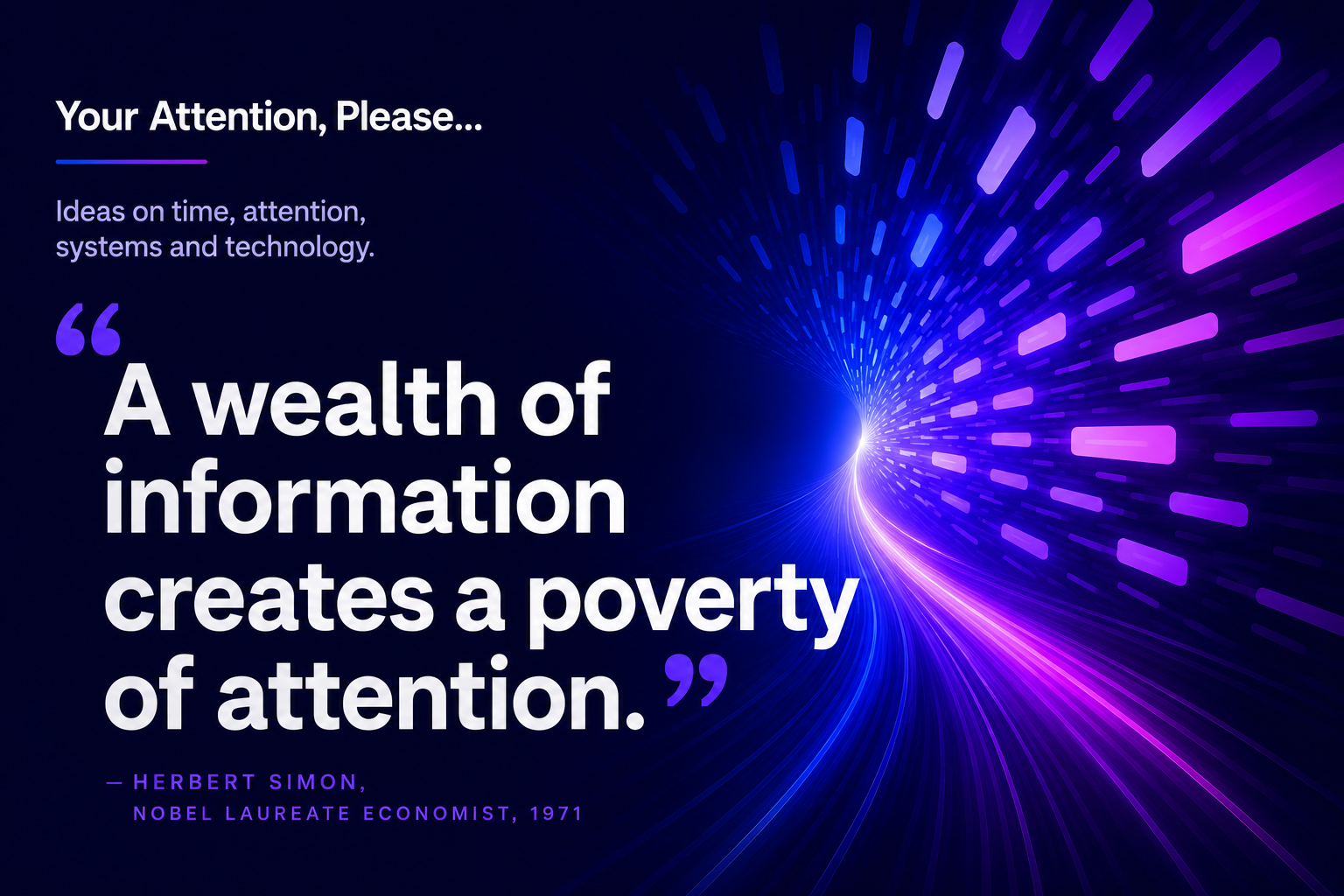
“A wealth of information creates a poverty of attention.” — Herbert Simon, Nobel laureate economist, 1971
Why are so many of us compelled to look at our phones dozens or even hundreds of times per day? Why do today’s systems actively waste our time and attention, while others are simply indifferent and leave the burden to us? What if instead of technology undermining our ability to focus on what matters, it enhanced it? What if there was a better way – one that gave us back the time and attention we’re losing? This piece explains the problem, what a solution looks like, and why I'm building that solution.
I. The Problem: Two Enemies, One Result
Our attention is under pressure from two directions.

The firehose: Most of us rely on a handful of systems to stay connected and informed: email, workplace messaging, text and the web. These systems were built to deliver content, not to understand it. Over time, filtering tools have appeared. The simple ones, like email rules and folder routing, work for predictable patterns: sorting newsletters into a folder, routing mailing list traffic to a label. Priority inbox and similar features go further, using machine learning to try to predict what’s important, but as we’ll see, their decisions are opaque and uncorrectable. None of them can determine whether a message needs a response, a decision, or nothing at all. For everything beyond the simple cases, the person is still the filter. Most people don’t bother setting up more than a few rules because the effort-to-value ratio drops off fast. At scale, people either check constantly or risk missing something that matters.
The attention economy: social media algorithms optimize for engagement because engagement sells ads. Clickbait headlines are engineered to get clicks, not to inform. Notification badges exist to pull people back in. These systems are designed to capture attention. Many people see it clearly, but seeing the problem hasn’t produced a solution. What begins as a platform serving its users gradually shifts to serving its advertisers, then its shareholders — a pattern so predictable that journalist and author Cory Doctorow gave it a certain “colorful” name.
Both produce the same result: people become the triage engine. Dozens of times a day, across every system, making the same decisions. What needs action? What needs tracking? What can be ignored? Nobody asks for that job. It just happens, consuming time and wasting attention that’s better spent elsewhere.
II. The Human Cost
For many of us, this is daily life:
- Fear of missing something critical. Checking constantly because the cost of missing something is so high.
- Falling behind on things that matter. The backlog grows and fear of missing something good grows with it.
- Constant vigilance. Cycling through systems all day, not because any single check is valuable, but because not checking is too risky.
- Fragmentation. Information scattered across a dozen systems, with the person left to bring it all together.
For people who recognize this pattern, there’s often a low-grade anxiety underneath it that never fully goes away. Even when not actively checking, people might still worry about it.
Averages for Knowledge Workers per 8-hour work day
270 pings (emails + messaging)
Only 1h 12m of focus time
That feeling isn’t unfounded. The costs are actually measurable. Microsoft’s 2025 Work Trend Index found that the average employee receives 117 emails and 153 chat messages per day (270 separate messages), based on telemetry from billions of Microsoft 365 productivity signals. RescueTime’s analysis of nearly 50,000 knowledge workers found they average just one hour and twelve minutes of uninterrupted focus time in an eight-hour day. More than half the workday goes to communication overhead, not the work itself.
This isn't just a waste of time; it’s a meaningful drain on human energy. Psychologists call it decision fatigue—the reality that every micro-judgment we make ("Is this urgent? Can I ignore this? Should I archive?") uses up a finite reserve of mental willpower. By the time someone sits down to do the work that actually matters, significant mental energy may already be expended. That means less creative energy is left to solve hard problems.
These aren’t just productivity statistics. They represent choices being made for people. Time is zero-sum. When it’s spent sorting through noise, it’s not spent on what actually matters: family, friends, rest, or simply the higher-value work people could be doing. When work spills past the end of the day because the day was consumed by overhead, the cost isn’t just professional, it’s personal.
Nobody’s job description says “spend a quarter of the day sorting messages,” yet research consistently shows that’s what knowledge workers do. Anthropologist David Graeber observed in Bulls**t Jobs (2018) that modern work is full of tasks that feel necessary but produce no real value. Information triage may be the purest example: essential to survive the system, but contributing nothing to the work that matters. It’s become so normal that most people don’t question it.
III. My Story: Failed Productivity Hacker
I tried every tool, every system, every hack. Inbox zero. Time blocking. Priority inboxes. Notification management. Each one helped for a while, then the volume won. I’d internalized the constant sorting as “just part of the job.” Both problems were real and nothing solved either one. The attention economy was well known and people were frustrated by it. The firehose was just as painful, but less discussed. People normalized it as diligence rather than recognizing it as an unnecessary tax.
That’s when the question shifted from “how do I keep up?” to “why isn’t anyone solving this?”
IV. Why Nobody’s Fixed This
The Incumbents Fall Short
The companies that own the major email and productivity platforms have tried. Gmail’s priority inbox, Outlook’s Focused Inbox, and smart categories like Promotions and Updates all attempt to sort content automatically. These are genuinely different from simple keyword filters. They use machine learning to organize messages. The problem is that their decisions are opaque, uncorrectable and wrong too often. When Gmail puts something in the wrong tab, there’s no recourse. With spam, there’s at least feedback loop: mark something as spam or not spam. Priority inbox offers no equivalent. There's no way to control what goes where or create new categories. It’s a black box people are asked to trust with no way to correct it.
Even if they improved, there’s a structural limit. Each company only focuses on their own platform, which doesn’t work when the firehose comes from everywhere: work email, personal email, news, video platforms, podcasts, messaging.
These platforms are also single-identity by design — one account, one set of content. Many people juggle multiple accounts and identities, switching between work, personal, and side projects. Because these systems remain strictly siloed, the individual is forced to act as the manual bridge between them. This constant context-switching adds a persistent layer of friction to the day.
Personal Productivity is a Treadmill
Most innovation in this space has focused on helping people process more information faster. Very little has focused on helping people determine what deserves their attention in the first place. The productivity industry frames this as a personal discipline challenge. People just need better habits, better tools, better routines, but that’s asking individuals to out-muscle systems built by sophisticated companies. Every time someone develops a coping strategy, the platforms adapt. The treadmill gets faster. A wave of email productivity tools has tried to help: faster keyboard shortcuts, smarter snoozing, AI-generated summaries and auto-replies. This approach has hit its limit. Faster processing is still processing. They’re also all locked inside email, which means they can’t touch the cross-source problem.
Georgetown computer science professor Cal Newport identified the deeper issue in A World Without Email (2021): what he calls the “hyperactive hive mind,” an unplanned workflow where email and messaging became the operating system for every kind of work. Nobody designed this system. It just emerged, and people are trapped in it.
The Agent Hype Misses A Critical Point
The current AI zeitgeist says “agents will handle everything.” AI agents, unlike simple chat bots, can do multiple steps and work autonomously for minutes or even hours. The promise is appealing: let an agent manage the inbox, sort messages, handle the triage. The problem is that for someone who can’t afford to miss a critical message, “handles it correctly most of the time” isn’t good enough and agents that do all of these tasks end to end are not reliable enough today. This isn’t a capability gap that closes with the next large language model release. It’s a structural issue with how these systems work.

There are two problems with using AI agents for high-stakes workflows:
- The longer and more complex the prompts are, the less reliable the results will be, as demonstrated in research by Adobe. Triage is complicated. Doing all of this work in prompts inevitably leads to complexity for the agent to try to sort out. The more cases, options and details added, the less reliable the agent becomes.
- The more prompts that need to be chained together, the more errors will compound. If every step is 99% accurate, with 100 steps that means the entire process will only be accurate 37% of the time.
For shorter, simpler tasks, by contrast, AI large language models (LLMs) can be highly reliable. Their super power is in handling unpredictable situations or areas where judgment is required. “What’s the topic covered here?”, “What kind of content is this?” are examples of things that LLMs do incredibly well where traditional software struggles.
Traditional software, by contrast, already can do the tedious, repeatable boring stuff incredibly well and reliably where LLMs and agents struggle.
The Collective Action Trap
Prominent thinkers have talked about these information overload and attention economy problems for decades. Simon named it in 1971. Graeber, Newport and Doctorow each added new insights. Yet all of their proposed solutions require collective action: organizations redesigning their workflows, governments passing regulation, industries reforming their business models. These can be tempting solutions, but they all require someone else to go first and large groups of people to work together. Meanwhile, the person drowning in 270 pings a day is still waiting.
V. The Insight: Content Already Carries Necessary Signals
Every piece of content already contains details that determine how it should be handled. An approval request is fundamentally different from a newsletter, even if they arrive in the same inbox. A calendar conflict requires action; a podcast episode doesn’t. The signal is there: who sent it, what type it is, whether it needs a response, how urgent it is.
People already read this signal. They’re just doing it manually, at a scale that means it can take hours to complete if it’s ever completed at all.
Systems read this signal too, but often for their own purposes: ad targeting, engagement optimization, selling attention to someone else. It’s seldom being read to help you. Columbia law professor Tim Wu traced this pattern through a century of history in The Attention Merchants (2016) — industries learning to capture human attention and resell it, from newspaper ads to social media feeds. The tools change, the extraction doesn’t.
So the proof is there, these systems can extract signal. They’re just not doing it primarily for our benefit. Yet.
VI. Knowing What Deserves Attention
What if there were a way to know what deserves our time and attention, and confidently ignore everything else?
Think of what a great executive assistant does. They don’t just keep things away from the person they support. They know when to tap them on the shoulder. An urgent request from a key customer gets through immediately. A time-sensitive decision doesn’t sit in a pile. But they also protect focus: the things that don’t need attention right now don’t merit an interruption. This is a gatekeeper who knows exactly when to open the gate.
It’s not just urgent versus not urgent. Some things are important but not time-sensitive. They genuinely deserve attention when there is space for them: an industry article relevant to a key decision or a thoughtful message from a friend or colleague. If those get buried in noise, something real is lost. If they compete with urgent items, they create a distraction. They need their own place that’s visible when the time is right, invisible when not.
Delegating that prioritization judgment is a big request. People’s checking habits exist for rational reasons. What if something critical lands and it’s not seen for hours? What if the system buries an urgent request from someone’s manager? What if a client email sits unread because an algorithm decided it wasn’t important? These aren’t irrational fears. They’re earned from experience. People maintain these habits because the cost of missing something is real: a lost deal, a missed deadline, a damaged relationship. Any system that asks people to check less has to directly answer the question: how do I know nothing slipped through?
Any solution that asks people to change this behavior has to clear a high bar. It would need to show why every decision was made. Not after the fact, but as a basic property of how it works. The logic would need to be deterministic and predictable, not an opaque algorithm that might change its mind tomorrow. When it’s wrong, it would need to be correctable, and the correction would need to stick. And the solution itself can’t play the same attention-capture game it’s supposed to protect against — no infinite scroll, no engagement tricks, no panic notifications. Trust isn’t a feature that can be bolted on at the end. It’s the foundation, and anything that doesn’t earn it will fail.
VII. The Vision
Vision: a world where people spend their time and attention on what matters most to them.
What would you do with an extra hour or more every day? What would you learn? What would you build? Which relationships would get more of your attention? What opportunities would you pursue? How much more capable would you be if your attention wasn’t fragmented?
Every hour reclaimed from managing information is an hour returned to be able to do something better. The vision isn’t a world with less information. It’s a world where technology handles the overhead so people can focus on the substance.
VIII. The Mission: Reclaiming Time and Attention
Mission: help people reclaim their time and attention.
IX. A Solution
We now know what hasn’t worked at today’s scale and speed:
- Simple filters based on keywords
- Opaque, uncorrectable, one-size-fits-all algorithms and machine learning for sorting and filtering in-bound content
- Personal productivity; just chewing through everything faster
- AI agents that try to do everything with AI, even parts that are much faster and more reliably done with traditional software
- Collective action solutions: laws, policies or tops-down mandates
- Making people be the aggregation layer across all systems, when the firehose comes from every direction
It turns out that Herbert Simon didn't just describe the problem back in 1971, he also described what a solution would need to do:
A general design principle can be put as follows: An information-processing subsystem (IPS) … will reduce the net demand on the rest of the organization's attention only if it absorbs more information previously received by others than it produces – that is, if it listens and thinks more than it speaks.
To be an attention conserver for an organization, an information processing system…must be an information condenser. It is conventional to begin designing an IPS by considering the information it will supply. In an information-rich world, however, this is doing things backwards. The crucial question is how much information it will allow to be withheld from the attention of other parts of the system
We need a system that listens and thinks more than it speaks.
With all of this in mind, I think an ideal solution would:
- Conserve attention, not ask the person to just go faster
- Earn trust: be reliable, transparent and correctable
- Extract the right signals to understand content and to make priority calls. It must be like a great executive assistant who knows when to interrupt and when to wait
- Work across information contexts that people actually deal with, not just a single identity or company platform
- Work in the world as it is, not in a world that has different mandates or policy approaches. It would allow people to take action now
The solution I envision is an information stewardship layer that sits between people and the systems competing for their attention. One that understands what information requires attention now and what can safely wait. One that helps people focus on what matters without requiring constant vigilance.
This requires two things that can be difficult to combine: AI and reliability.
AI extracts the signal: what it asks, how urgent it is, whether action is required.
Traditional deterministic software handles the repeatable workflows, sorting and filtering.
Each does what it’s good at.
This is fundamentally different from priority inboxes, which don't earn trust, and agent systems, which aren't reliable. A hybrid approach uses each technology where it's best suited: AI for understanding, traditional software for the repeatable and mundane.
This is what I’m doing with BrightFeed. It analyzes everything that comes in from connected sources, understands what each item requires and sorts it by priority. It listens and thinks more than it speaks, helping to ensure people’s time and attention go where they matter most.
X. Why I’m Fixing This
This problem became personal to me years before I started building the solution. I think it’s ridiculous that in 2026 so many of us are still driven by our tools rather than our tools serving us. Solving this is possible. The understanding of the problem exists. What’s been missing is someone willing and able to build it.
My career has been spent across both parts of the ideal system: building AI systems at a VC-backed startup in governance, risk, and compliance, where getting it wrong has real consequences, and building products, distributed systems, and data pipelines at Fortune 500 scale, where reliability isn’t optional.
There’s also never been a better time to start. AI tools give a technical founder massive acceleration. The costs to get going are manageable. I didn’t see a reason to wait for permission or a bigger team or a more convenient moment. The problem is here now, the tools to solve it are here now, and I have the skills and conviction to build it.
If this resonates, if you believe people deserve better than being the triage engine for systems that don’t respect their time, I want to hear from you. I’m looking for people who believe in this mission and want to help build it.
Stay connected:
- Sign up for the newsletter for occasional pieces on reclaiming time and attention.
- Comment on the posts, which are shared at blog.brightfeed.io
- Write to me at nick.martin@brightfeed.io.
- Learn more about the app
- Try the app